Relative to countries like Ecuador or Colombia – heck, even relative to the state of New York – Chile doesn’t have a lot of birds. Paradoxically, that makes it a great birding destination. Think about it: a lavishly illustrated field guide to the birds of the country can include a bonus section on the identification of eggs (!!!) and full-page photographs of the authors’ favorite species, and still slip easily into your handbag. Studying up on the birds you’re likely to see is relatively easy. Do you find hummingbirds frustrating, but love distinctive gulls and weird ducks? Do wren-like birds with long, spiky tails appeal to you? You’ve come to the right place!
But where Chile really stands out is the omnipresence of birds on the walls of its cities. As readers of this blog surely know by now, I love street art almost as much as I love birds. And Chilean street artists seem to have a strong ornithological bent. The walls of Santiago and other cities were practically a gallery of the birds of Chile; I could stroll neighborhoods and sharpen my identification skills at the same time.
Here, then, are some of my sightings.
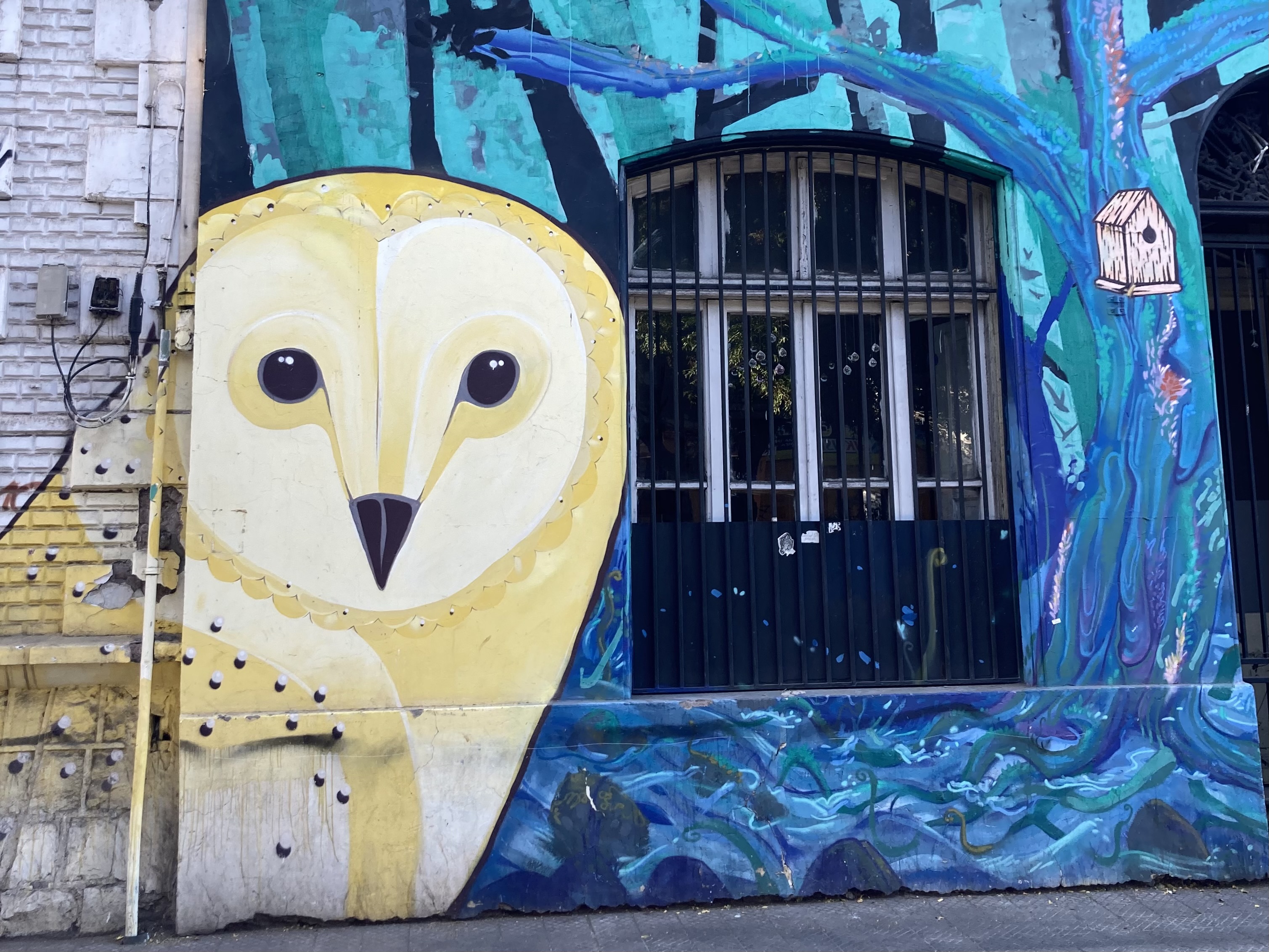
When they’re not assisting gardeners by snipping the tops off unruly growth, Rufous-tailed Plantcutters like to perch for long periods in high visible spots; Cornell’s Merlin app describes them as “generally sluggish – like an avian sloth.” My kind of bird! Imagine my consternation, then, when I failed to see even one during our first week in the country . . . except, that is, for this fine individual, seemingly an immature male, in Santiago’s Yungay neighborhood.
I would eventually spot a couple of backlit ones on Chiloe, one in a small city park in Viña del Mar, and – finally – several cooperatively slothful pairs in the Mantagua wetlands. What I never did see was one trimming a lawn.
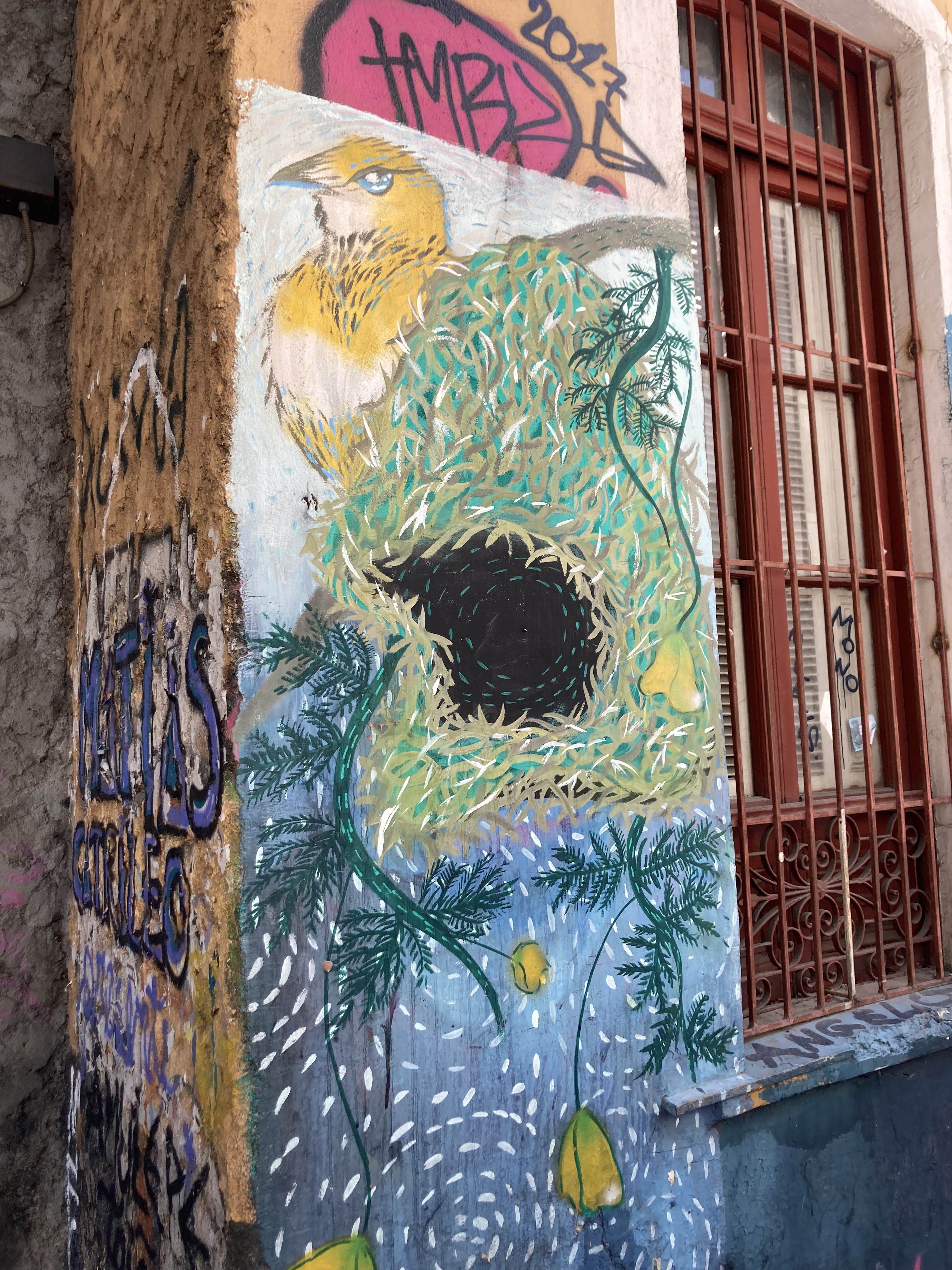
(The blue eyes are an esthetic choice by the artist; in real life they are a piercing red.)

I’m not sure who the guy is, but the bird is a Long-tailed Meadowlark. I was thrilled to see one in Santiago’s Parque O’Higgins, and later, many more perched on fences in the Los Lagos region. It’s always nice to see grassland birds thriving, especially when they’re as beautiful as these.
Even Eric was impressed when I pointed a pair out to him in Mantagua.
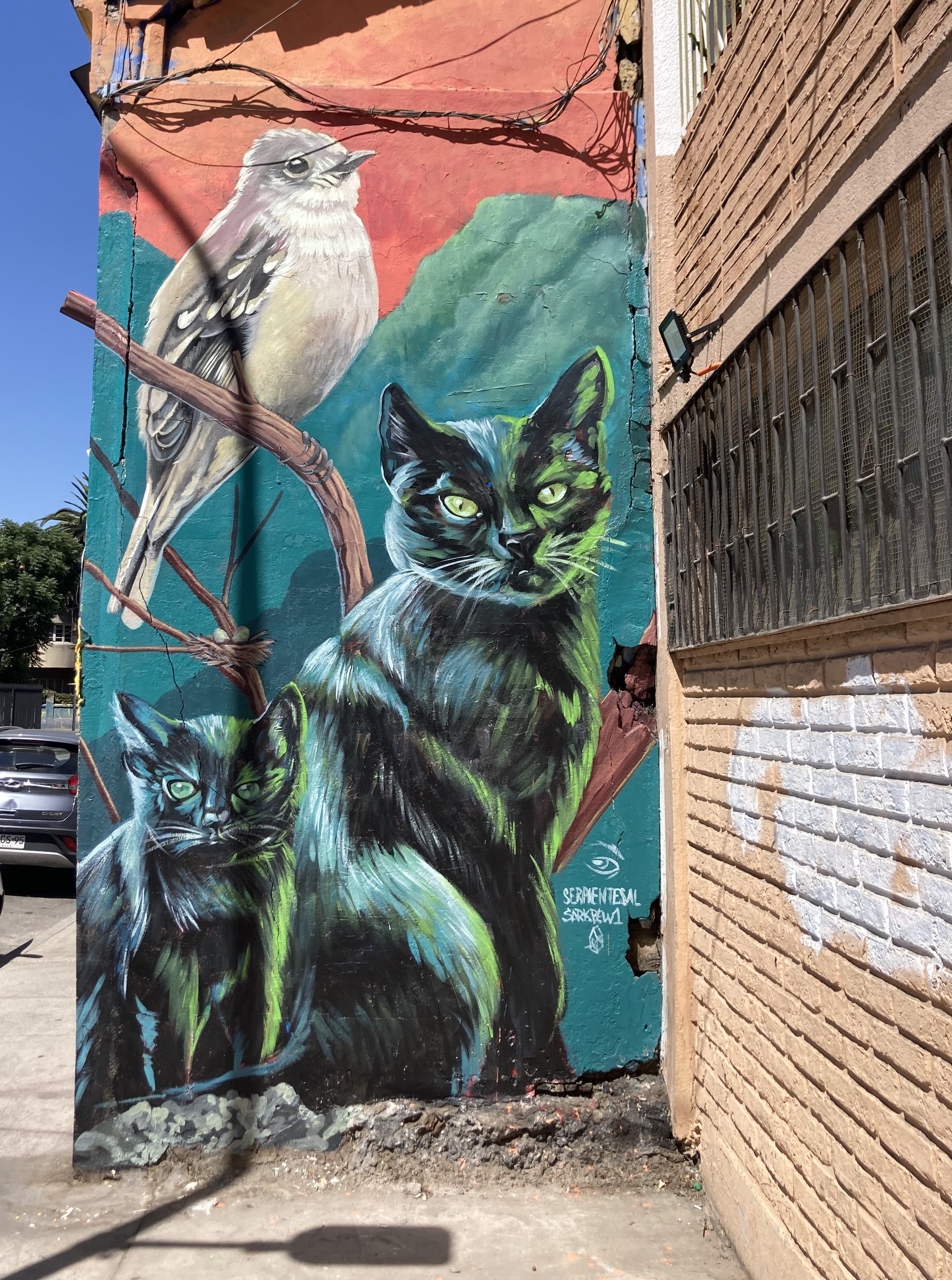
Street artists, like most people, tend to gravitate toward birds that are colorful or charismatic. What a nice surprise, then, to spot this White-crested Elaenia in Yungay . . . and what a nice surprise to be able to identify it! It’s not that I’ve become better at identifying drab flycatchers, it’s that Chile doesn’t have a lot of them. I actually found these elaenias more distinctive in the wild, where they often raise their namesake white crests, than on this wall.
I do worry about the bird’s proximity to those cats, which really should be inside.

Sometimes street art birds are as frustratingly elusive as their real-life counterparts. I’m not talking about fantastical, imaginary birds, their bright colors and extravagant tails serving as metaphors for beauty and freedom, but birds that appear to be closely-observed and painted from life. For example: what am I looking at above? Its general shape and preference for deep cover suggest a tapaculo of some sort, and the brown cap and white eyebrow and throat are good for a White-throated Tapaculo. So is the bamboo, if indeed those are bamboo stalks in the background. But White-throated Tapaculos don’t have white eye rings, and they prefer dry, rocky scrub to the kind of damp, mushroomy, sprite-filled forest depicted in this mural.
I’m going to have to let this one go.
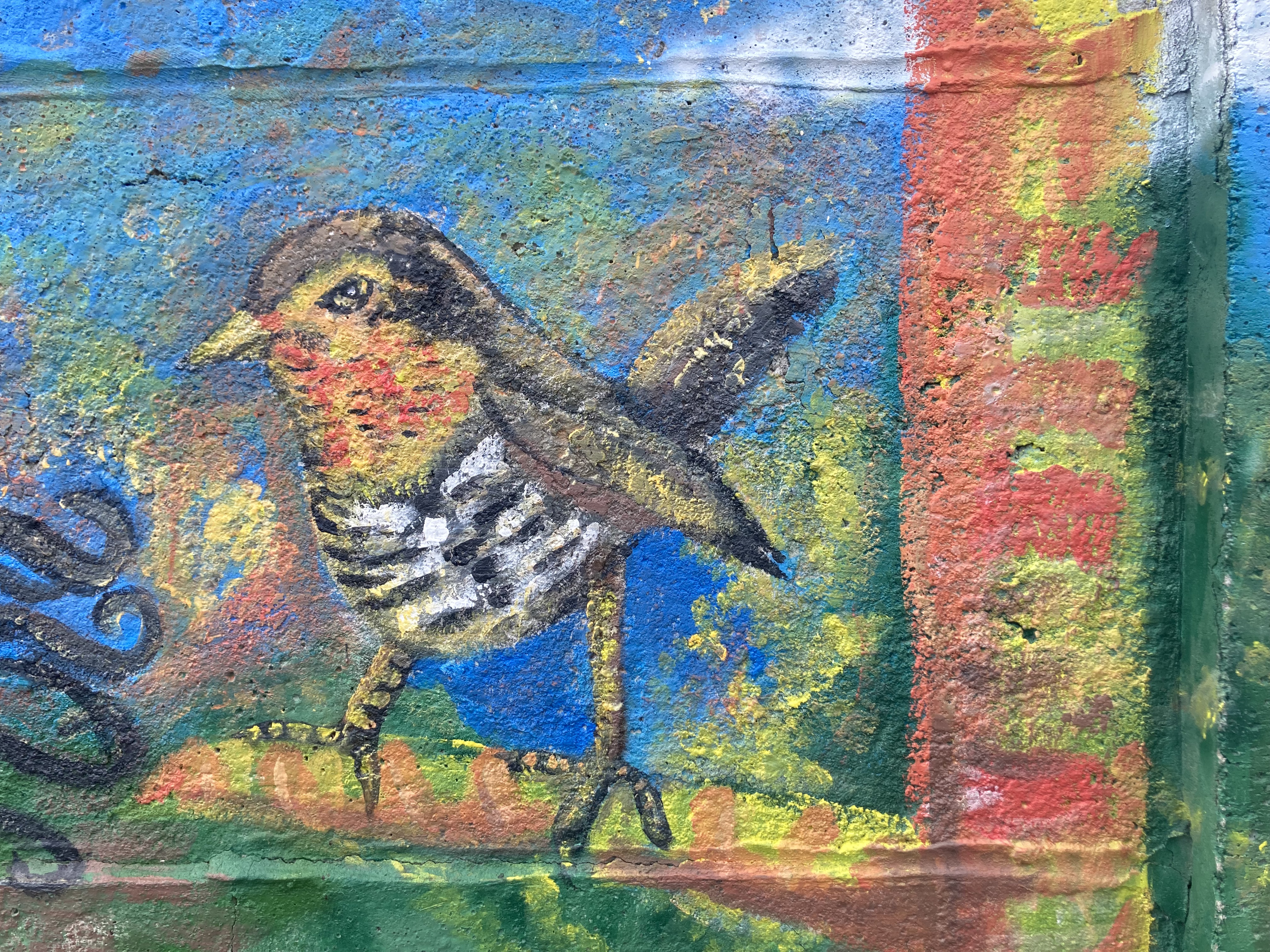
The Chucao is beloved in Chile. Start with the name: to English-speaking birders it’s a Chucao Tapaculo, but to Chilenos, it’s just a Chucao. Not like a one-named celebrity, but like your close friend whom you always and only think of by their first name.
It’s an unlikely bird to inspire such affection. Its earth-toned plumage is pretty, but not spectacular. Nor is it majestic. Instead of soaring overhead, it skulks along the forest floor. It can be surprisingly confiding, but no one would ever describe it as a friendly, backyard bird – and its relatively restricted range means that most Chilenos have never seen one.
Nonetheless, our first hotel room in Santiago (well outside the Chucao’s range) had a picture of one on its door. At the National Museum of Natural History, a perky Chucao gives tips to visitors. The national park in Chiloe features Chucaos prominently in its signage. The Cafeteria Chucao in the town of Castro scales the heights of Chucao fandom with an impressive collection of Chucao photos, Chucao paintings, Chucao woodcarvings, plush Chucaos, and other Chucao tchotchkes.
And, of course, Chucaos show up frequently on walls.
That made my inability to see or even hear one in real life a source of considerable frustration. In Chiloe National Park, which I understood to be one of the best places in the country to see them, I headed out early and went out again late, with the same result: nothing. Was it the rain? My incompetence? Who knows. My experience outside Puerto Montt was the same, and I began to reconcile myself to failure.
Finally – finally! – we saw them, in the suitably damp and mysterious Alerce Andino National Park. We heard them first, a loud ringing song that sounds as though it must surely be coming from a much bigger bird. Then I spotted a small bird directly alongside the trail, thoughtfully unconcealed. I would have recognized it by its profile even if I hadn’t seen its rusty breast. At that point, as often happens with a too-much-desired bird, it was as though the floodgates had opened. I began to hear them everywhere, and on our return to the parking area, I even spotted one hanging out by the rangers’ station.
The Chucao in the photo above isn’t the most skillfully-drawn wall Chucao of our trip by any means, but it’s the first Chucao street art I saw after seeing an actual Chucao, and therefore celebratory.
. . .
In a world of gaudy tanagers and ridiculously fast hummingbirds that change color when you tilt your head, the understated birds of Chile come as a relief. Some are elegant (Gray Gulls), some are comical (Flightless Steamer-Ducks), some are just plain weird (Des Murs’ Wiretail) . . . and some wait patiently for you, frozen in paint on walls.
 Not another Brooklyn blog