
Birds were the best thing about this past year. That’s generally true if you’re as bird-obsessed as I am, but it was particularly so in 2023. So much so, in light of the ongoing slaughter, destruction and privation in Gaza and the West Bank, that I’m forced to wonder: is it trivial to think of this bloody year in birds? Offensive, even? Should I set my binoculars aside in mourning, or at least have the decency to stop yammering about rarities and lifers?
Even if I should, I can’t. Birds have been, and still are, a source of joy for me and many others. They are beautiful; they ignore borders and fly over walls; they are fragile, and yet they endure in the most unlikely places.
And If I didn’t have them in my life, I’d be even more nuts than I am.
So, here goes: the year in birds.
2023 proved that when one has the time, resources and freedom to travel, one can see a shit-ton of birds: 804 species over the last 12 months, including 342 lifers. Those totals are swollen by a serious splurge on an extended birding tour of Ecuador. I wouldn’t have missed it for the world, and if you’re at all intrigued, I’ve included a link below. But as I look back on the year, I find that many of the birds I saw on the tour are a bit of a blur. Was it a Glistening-green Tanager we saw, or a Grass-green one? What’s the difference between the two? And where was this, anyhow? Try as I might, I can’t summon up a mental picture. New birds came so thick and fast that I often didn’t have time to appreciate them, and as a camera-less birder, I don’t have photographs to revisit.
Closer to home, this was also the year I achieved the entirely arbitrary goal of seeing a lifetime total of 300 species in Brooklyn.
January
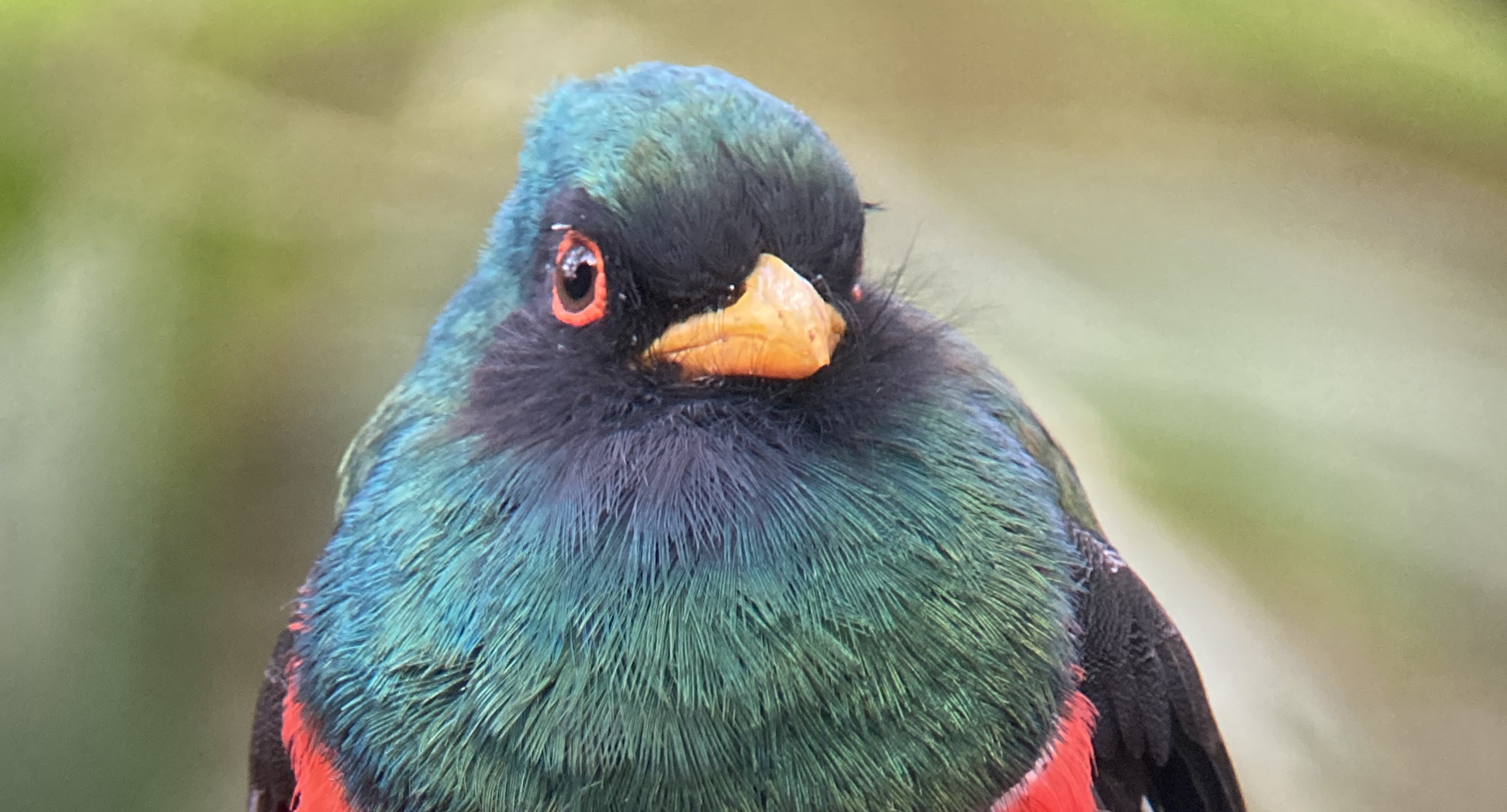
My Ecuador tour was organized by Brooklyn birder extraordinaire Gabriel Willow (you can find his website, with information on upcoming tours, here), with Roberto Cedeño, the dean of birding guides in Ecuador, accompanying us. (That’s his digiscoped trogon photo at the top of this post, I can’t believe it was taken with my phone.) On our first morning, we stopped at a roadside cafe and restaurant northwest of Quito which, like many such spots around Mindo, comes with hummingbird and fruit feeders standard. And there – bam! – was a Red-headed Barbet, a bird featured on Gabriel’s trip website because it’s so ridiculously colorful, so perfectly calibrated to provoke bird-lust. I think we saw half a dozen tanager species and a dozen different hummingbirds before the waiter arrived with our patacones.
Do I remember much about any of them? I’m afraid not.
The birds that have stayed most vivid in my mind are those I managed to identify on my own, like the charming Masked Water-Tyrants flitting along rural roads in the lowlands, or the Slate-colored Grosbeak that graced a tree outside my cabin at Reserva Rio Canande. Those, and the big, goofy birds like Horned Screamers, the vaguely obscene Long-wattled Umbrellabird, and of course Comb Ducks. It’s not every bird that provokes screams – “Coooooooomb Duck!!!!” – from the back of the van.

February
My Ecuador trip stretched into February, when I saw what’s probably the rarest bird I ever have and ever will see in my life: the Jocotoco Antpitta. First documented by ornithologists in 1997, much of its known population – estimated to number in the hundreds – lives in a single mountainous reserve in southern Ecuador.
Antpittas are generally reclusive birds, more often heard than seen. But birders want to see them, and a number of Ecuadorian lodges now lure them to worm feeders. (An interesting project for another day, and/or another writer: tracing the development, refinement and diffusion of techniques from the guy who started it all, Angel Paz, through various familial and business networks across Ecuador.) It’s quite a show. At Reserva Tapichalaca, a rustic seating area faces a stage-like opening in the greenery. The reserve’s guide and antpitta-whisperer places worms in a carved-out section of a strategically-placed log. Then – following the practice pioneered by Angel Paz – he begins to call the birds by their assigned names:
“Di-eeeeee-goooo!”
“Pan-chiiiiii-toooo!”
The group of us held as still as we could, barely daring to breathe, willing total silence and invisibility, and almost achieving it. But not quite: it was a soft intake of air from one of the others that alerted me to the presence of . . . Diego? Panchito? No matter – it was The Bird.
My first glimpse was of a shadowy presence in the vegetation. Then suddenly it was in the open, creeping along the log/worm feeder. I heard more stifled gasps as others caught sight of it. It looked exactly like its advance publicity: the classic antipitta shape of a round, almost tail-less body on stilt-like legs, plumaged in earth tones but with a boldly-patterned head. Camera shutters whirred.
But wait, what was this?! A second bird had crept into view while we were focused on the first. For the next I’m-not-sure-how-many minutes, Diego and Panchito took turns venturing boldly out and then retreating into the vegetation. The show went on long enough that several of us, including me, lost focus and began to pay more attention to the rapturous expressions on the faces of our colleagues than to the birds themselves.
It was very much a production, which sounds critical, and maybe is just a little, but it was also great. If a bit of show biz flair is what it takes to draw visitors and their dollars to the network of lodges and reserves that are protecting Ecuador’s diverse habitats from logging, mining and monoculture – well, then, bring it on.
Back in Brooklyn, I resumed birding in colder and grittier surroundings – like the ruined piers-turned-park of the old Bush Terminal. On my way out of the park after not seeing any rare gulls or weird ducks, I caught a quick glimpse of a meadowlark as it flushed from one patch of grass and disappeared into another. That was cool: meadowlarks aren’t so common in Brooklyn, especially on gray winter days along the industrial waterfront. I mentioned it to another birder, in one of those “oh by the way” asides motivated in part by genuine helpfulness and in part, if one is brutally honest, by a desire to show off one’s birding prowess. He refound it and snapped a photo.
The difference between him and me is that he pays attention to small details, and something in his photo of the bird seemed just a little off. He researched, he consulted, and he arrived at an expert conclusion: the bird we (and others – it had evidently been hanging around for several weeks) had seen was a Western, rather than the expected Eastern, Meadowlark.
Thanks to Josh’s assiduousness, I was one species closer to joining the ranks of birders who have seen 300 species in Brooklyn. Western Meadowlark = 297.
But wait, there’s more! Swainson’s Hawks are a western species that winters in Argentina, two very good reasons for them not to be in New York City in February. And yet one had been seen in Staten Island earlier in the winter, and then evidently moved to Brooklyn, where it was spotted several times around Green-Wood Cemetery, always briefly. Suspicion was growing that it actually spent most of its time on the waterfront. Where, though? After documenting the meadowlark, Josh – who was on a serious roll – found the hawk in the vicinity of an industrial recycling facility at the foot of 32nd Street. That’s where I saw it the next day, joining a gaggle of birders whose expensive optical equipment and intense interest in recycling thoroughly puzzled the Amazon Flex delivery drivers coming and going from their depot.
Two Brooklyn lifers in two days!
March
March always brings American Woodcocks to Green-Wood Cemetery, and who doesn’t love those feathered potatoes? No one who’s ever seen them, that’s for sure. Less expected was the Cliff Swallow swooping over the cemetery’s Sylvan Water at the end of the month. I’ve always found swallows challenging, but this one took pity on me. It flew low, directly at me, again and again. The vibe was patient teacher with rather dim student. “See my squared-off tail?” it seemed to be saying. “Have you checked out my buffy rump? And here, get a load of my bright white forehead.”
Cliff Swallows breed in at least one location in southeast Brooklyn, and are spotted occasionally around the borough during migration, but I’m told this was the earliest recorded arrival date for one.
April
The highlight of this month was a mother-daughter trip to Nevada and Utah to celebrate Katie’s 30th birthday. I was appropriately abashed a few months back when she mentioned in an offhand way that she had never visited a U.S. national park (she actually had, during long-ago trips to see her paternal grandmother who lived just outside Rocky Mountain NP – but as she was in diapers at the time, her forgetting is understandable), and resolved to show her a bit of the desert west.
Katie was nothing if not a good sport about the non-national-park destinations I worked into our itinerary (the water treatment facility in Henderson, NV, just outside Las Vegas; a small and not especially scenic reservoir on the edge of Kanab, UT, where I got my lifer Franklin’s Gull), but the highlights were, of course, Bryce Canyon and Zion National Park. In bird terms, the highlights were the California Condors we saw in Zion – Katie was the first to spot one, hunkered down on a guano-streamed ledge – and the Greater Roadrunners at the Henderson facility on our very last day. One speared and ate a lizard while Katie watched (I was fumbling with my scope and looking elsewhere at the time).
I’d been home for just a few days when my friend Radka found a weird looking bird perched on Duck Island in the lake in Prospect Park. Was it a cormorant? A heron? Neither, as it happened: it was an Anhinga, a bird of sourthern swamps that rarely ventures this far north. As soon as I got the alert I was pedaling a Citibike to the Peninsula as fast as my still-slightly-jet-lagged legs could manage. Radka’s Anhinga was Brooklyn bird #299.
May
May brought my customary trip back to Toledo, Ohio and its environs, where I started birding lo these many years. This year’s visit was made bittersweet by my mom’s recent stroke and move to assisted living. I spent more time with her, and less time birding, but I still managed to bird a lot. It was comfort birding: low-key, not chasing rarities or lifers, just enjoying birds I remembered from my childhood (Eastern Meadowlarks!), some I overlooked back then (how did I not appreciate Lark Sparrows?) and some that, to the best of my knowledge, weren’t present in the area, at least not in numbers, when I was growing up.
That last category would certainly include American White Pelicans. They’re so big, so goofy, so nature documentary-ish – in short, so perfectly designed to catch the attention of a bird-obsessed pre-teen – that I would certainly have remembered seeing them. I mean, freaking pelicans flying over Lake Erie? Who wouldn’t remember that? I can only conclude that their range has changed over the past, gulp, half century. I now expect them on these May visits – and sure enough, I saw plenty. Mostly flyovers, but a few were close enough to get a gander at their bizarre, tumorous breeding horns.
June
Another month, another trip to Toledo. This time I took my mom to Howard Marsh (“hey, Mom, how about we go for a drive?”), where Dickcissels formed an avian welcoming committee along the entrance road. In Brooklyn, Dickcissels are a rarity to be chased. In Toledo, they’re a summer pleasure, like soft-serve ice cream.
At the end of the month, a turkey showed up in an unprepossessing strip that runs alongside Brooklyn’s Salt Marsh Nature Center. It’s the kind of place where people dump old furniture and appliances and set out aluminum pie plates full of food for abandoned and feral cats. Not exactly prime wildlife habitat, in other words. And yet, here was a turkey, highly unusual in Brooklyn. Was it a live poultry shop escapee? A petting farm animal? Its plumage, according to various turkey experts, seemed like that of a wild bird. Had a particularly adventurous member of the large Staten Island population decided to strike out on its own? No one knew.
Even apart from this individual’s uncertain provenance, it’s hard for me to get too excited about Wild Turkeys. Once you’ve seen them sitting on top of parked cars or strutting around parking lots, they lose a bit of their mystery and majesty. This meant I was facing a bit of a dilemma. As someone who knows that listing is ridiculous and tries not to care too much about it, my Brooklyn list is still special to me. Brooklyn is where I got back into birding in a big way, where I found a community of birders I like and respect and whose respect I hope to earn in return. Getting to 300 birds in Kings County is a milestone to be celebrated.
Did I really want #300 to be a turkey? I hemmed and hawed and dawdled, but the bird stuck around, and eventually, I couldn’t stand it any longer. So, for the rest of my life – no matter how many more great birds I see in Brooklyn – I’m stuck with a turkey as my 300th. It’s a salutary reminder to not take lists too seriously.
July
July in Brooklyn is the birding doldrums. It’s hot, the migrants have come and gone and not yet returned, the breeding birds are quiet, and the mosquitos are fierce. But if you can beat the heat and the crowds, Plumb Beach offers noisy oystercatchers, acrobatic terns – and, this past year, if you were lucky, Brown Pelicans.
I was not lucky.
Birding luck is highly correlated with just getting out there, and when “there” is Plumb Beach and you don’t have a car, well, getting out there is tough. Running is my birding super-power, and the run to the beach from the train early in the morning isn’t actually that bad. It’s the run back, in the stultifying heat, that’s killer. Plus, you can’t run with a scope, and birding the coast without a scope means most of the birds you see will remain unidentifiable specks.
The upshot of all this is that my sporadic trips to Plumb never coincided with those of the several pelicans that visited the beach regularly last summer. I did get to see many Least Terns, though, which is always a pleasure.
August
Another trip to Toledo to see my mom, another foray to Howard Marsh – this time a quick solo trip at the end of the day. Even in the fading light, the Buff-breasted Sandpiper feeding on one of the mudflats stood out. With its gentle, wide-eyed face and short bill, it made me think of a dove on stilts.
This was a life bird for me, and I was thrilled. As luck would have it, one also showed up in Brooklyn while I was in Toledo. A life bird seen in Brooklyn is of course superior to a life bird seen anywhere else, but Toledo is a close second, so I’m not complaining.
Besides, I saw Brooklyn bird #301 a few days later, when a Grasshopper Sparrow showed up at Green-Wood Cemetery. I hear these birds (barely) as they sing from the tall grass every spring in Toledo, but it was fun to (a) actually see one up close and (b) see it in Brooklyn.
Plus, it helped me move on from that turkey.
September
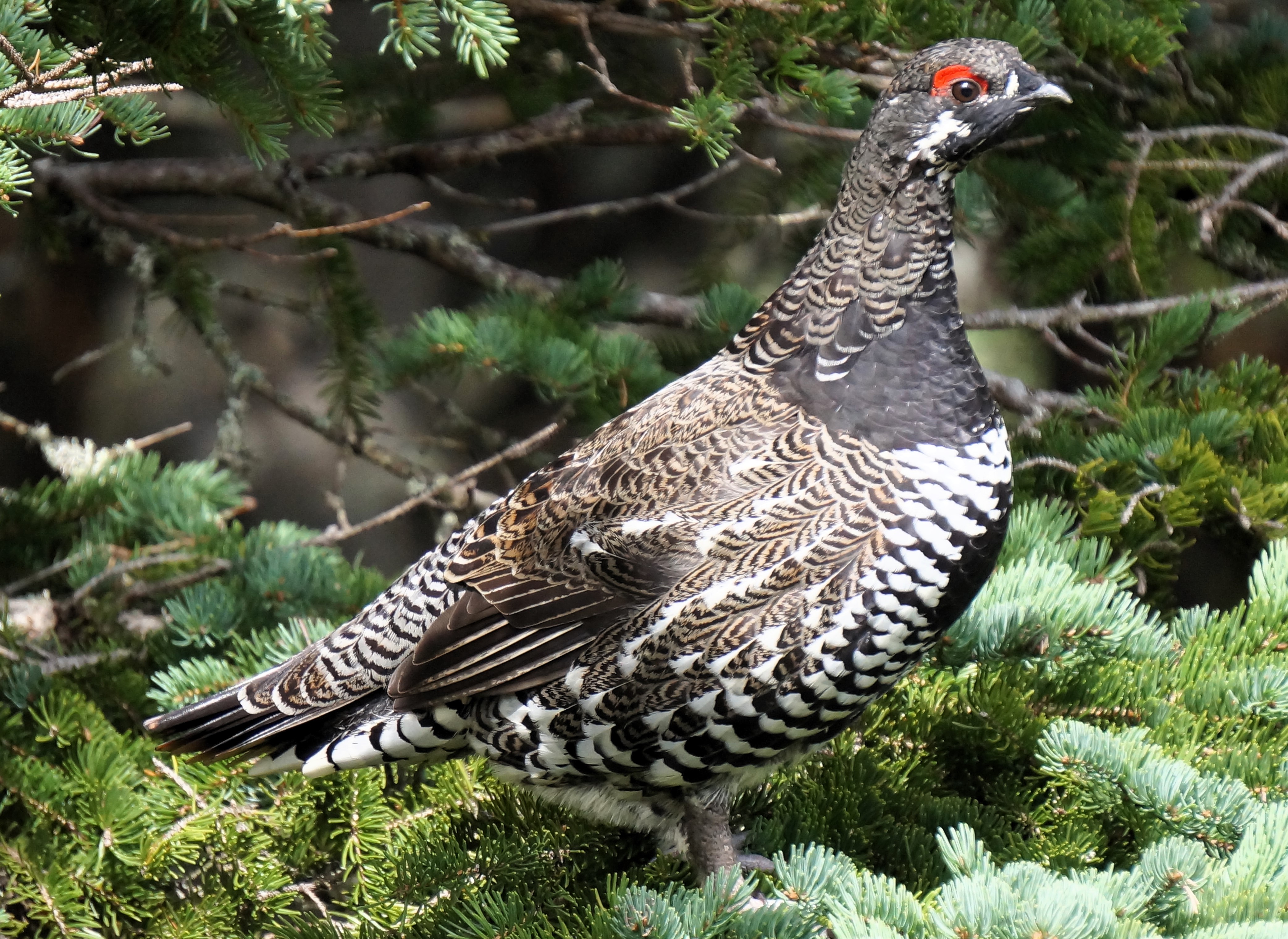
After one trip to the Adirondacks and two to northern New England in 2022, my list of boreal targets was unchanged. It was as though I was operating under some kind of north woods curse. Adding to that cursed feeling was our uncanny ability to cause hurricanes to veer toward Atlantic Canada whenever they heard Linda and Eric were planning to visit Nova Scotia. In 2022 it was Fiona, and we (wisely) canceled; last year it was Lee, and we stayed the course. Lee blew inland and we arrived on Cape Breton to crashing surf and rainbows and news that the famous Skyline Trail – where in my feverish imaginings Spruce Grouse scamper at your feet and Boreal Chickadees land on your head – was closed.
It stayed closed for the next day, as well, out of the proverbial “abundance of caution.” I tried my best to focus on the spectacular scenery along the Cabot Trail and enjoy the Northern Gannets playing on the wind, but I was of course disappointed. On the third day, we picked up butter tarts at the crack of dawn and headed to the trailhead to be among the first to celebrate its reopening – only to find the barriers were still up. We idled in the turnout with a handful of other early arrivals, discussing our options. Or Eric did, anyhow. Fidgety, I scanned the trees along the road for birds. Mostly I saw juncos. Then something gave a sharp call, I saw movement high up, and the movement finally resolved into a woodpecker that was – yes! – a Black-backed Woodpecker.
One of the cars at the turnout maneuvered around the barriers and continued on toward the trailhead. Good citizens that we are, Eric and I opted for a nearby bog trail until things were sorted out. We’d already walked the short loop our first day, but what the heck. I saw more juncos and then heard an unfamiliar chip call and saw something – two somethings, actually – land in the top of a spruce. They were White-winged Crossbills.
I was on a boreal roll, it seemed. Nothing was going to stop me now!
Sure enough, the barriers to the Skyline Trail had come down during our absence, and we proceeded to the vast parking lot that leads to a kind of gravel maintenance area that leads to the trailhead. Guess what was scampering around in the gravel, practically at my feet? A Spruce Grouse, of course.
In roughly an hour, I’d conquered three of my boreal nemeses.
To see the fourth, I had to hike about three quarters of the Skyline Trail. On the return portion, I heard a strange-sounding chickadee, and then another. While I didn’t actually have a Boreal Chickadee land on my head, they were all around me, tiny and vocal and adorable.
Nova Scotia was worth the wait.
October
From time to time the cousins of Eric’s generation plan reunions in a place convenient to those who are oldest and least able to travel, which as it happens, is California. This year’s took place in Palm Springs. We flew into LAX, and at my insistence, headed for a small city park conveniently located just off the 105, in our direction of travel. The park is named for MSU great (oh yeah, he was a Laker too, I guess) Earvin “Magic” Johnson, and for some months, it had been home to a magical goose.
A Tundra Bean-Goose, to be precise. Just saying that name makes me smile.
We had a dinner reservation with the in-laws and cousins in Palm Springs, and Eric offered me a maximum of 30 minutes to find this bird I was so obsessed with. I figured I could stretch that to 40 if I had to, but I was also keenly aware of how much he puts up with from me, and the importance he placed on this family dinner. I speed-walked from the parking lot to the small lake at the center of the park, then hesitated; which way should I go? Clockwise would take me toward some willowy foliage, counter-clockwise toward a rather barren, but goosey, picnic area.
I could see Eric glancing nervously at his watch. I couldn’t afford to choose wrong.
I opted for the picnic area, trying to stay calm as I sorted through the coots and Canadas and weird domestic hybrids packed tightly together. I rounded the shore toward the picnic area, feeling increasingly doubtful of my chances. The clock was ticking.
An older couple sat side by side at one of the picnic tables, talking as they looked out at the water. Practically at their feet, sitting on the dirt, was a small brownish goose with a bi-colored bill.

“That?” asked Eric incredulously, when I told him I’d found the goose and we could go. I had to grant him the point: it was, to be honest, one of the least-impressive geese I’ve ever seen.
Total distance, per eBird: 0.46 miles. Total time: 14 minutes. We made it to Palm Springs with time to spare.
November
From California, I continued solo to Mexico, where I spent a week in Puebla state immersed in Dia de Muertos festivities – and, of course, birds – before meeting Katie in Mexico City.
For some time, the town of Cuetzalan in Puebla’s Sierra Norte had been a fantasy destination for me. It’s part of Mexico’s network of “pueblos magicos” – smaller cities and towns offering some kind of unique cultural or gastronomic or natural experience. Cuetzalan offers all three, and some pretty amazing birding.
I knew I would see new birds, but other than that, had only a limited idea of what to expect. That was part of the fun. Cuetzalan is, as they say, “underbirded” (oddly, one rarely hears places like Brooklyn described as “overbirded”). Scanning eBird checklists made me feel like a stalker; most were from one individual who seems to visit from Mexico City (okay, I did click on his profile) every few months. Despite his efforts – and he’s clearly a skilled and prodigious birder – the eBird bar charts that tell you what you might expect to see in a given area are barely populated for Cuetzalan. So I was basically on my own, and it was a blast. Each bird I managed to spot and identify was a small triumph, from the noisy but hard-to-see Spot-breasted Wrens that sang from every other bush, to the spectacular Blue-capped Motmot that was a cinch to identify (who else has turquoise tail streamers?), to the Common Chlorospingus that were indeed common, but gave me fits for a full day because the Mexican variety looks quite different from the default photos in Merlin, and to hold down the weight of my luggage I had not packed a comprehensive field guide to the birds of Mexico.
I would have seen more birds if I had gone with a guide, but it would have been a very different kind of trip.
December
For the post-holiday drive back to Brooklyn from Detroit and Toledo, our rental car was loaded with fewer presents than in years past, but with more nostalgia. The flat fields and scattered farmhouses along State Route 2 fill me with a peculiar tenderness. And when those fields are dotted with hundreds of Tundra Swans grazing on the stubble, as they often are this time of year, I see them in the light-streaked, overexposed tones of the old slides my dad converted into digital images and presented, on neatly labeled CD-ROMs, to my sister and me.
I closed the year with a quick New Year’s Eve day trip to Riis Beach on the Rockaway peninsula. Or rather, it was as quick a trip as Sunday subway and bus service would allow. A group of Harlequin Ducks had been reported, and I was keen to see them. Not just because they’re great ducks, with a terrific Latin name (Histrionicus histrionicus), but because the symmetry of ending 2023 with the same bird with which I ended 2022 appealed to me.
By the time I got to Riis, there weren’t the crowds I was expecting for such great birds. I supposed others had already come and gone, or perhaps, I realized, some people choose not to spend the last day of the year chasing ducks on a frozen beach. But I was glad to be on my own, glad to have to hunt a little, The ducks had drifted east, beyond the park itself, to an area of rather grand beachfront homes. They were clustered tightly together by a rocky jetty, occasionally diving and flapping – dare I say it? – histrionically. “Good-bye and good riddance, 2023,” I think they were saying.
I nodded, and headed back to the bus stop and on to the new year.
 Not another Brooklyn blog